A Tale of Two Futures
Future scenarios are most powerful when they stop being abstractions and become experiences. This is a narrative scenario that explores two contrasting approaches to the future of food in 2035: precision nutrition and regenerative farming. Instead of presenting them as separate scenarios side by side, it weaves both futures into a single story, making their tensions and potential convergences tangible through the characters of Maya and Stefan.
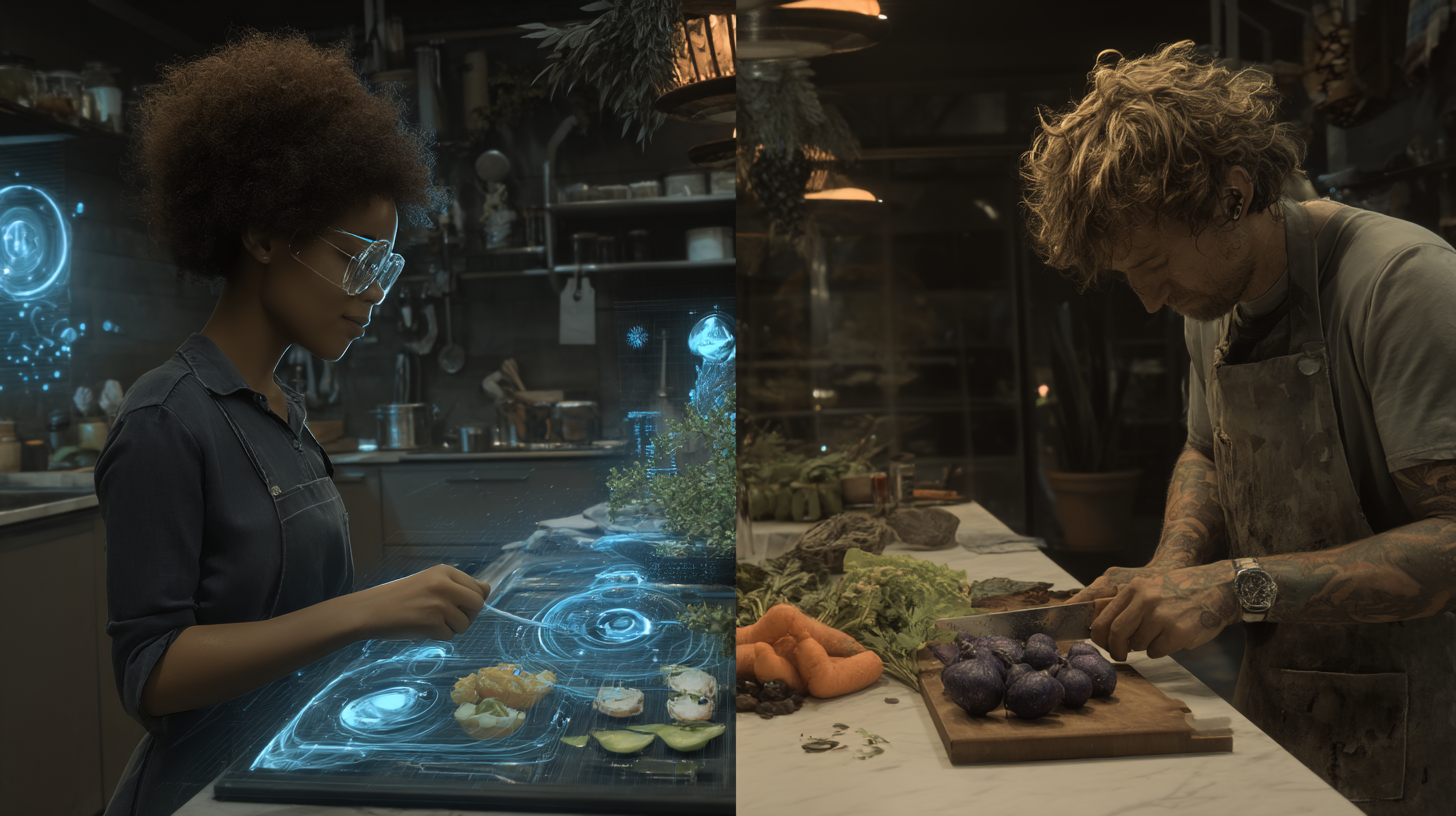
Maya adjusts her GLP-1 patch behind her ear: third-generation now, discreet and intelligent, continuously communicating with her gut microbiome monitor to optimize her metabolism. Unlike the weekly injections people used a decade ago, her system has recalibrated her entire relationship with food: from mindless consumption to intentional nutrition.
She glances at her kitchen shelf, smiling at the dusty jar of pistachios, a relic from the Great Pistachio Craze of 2025, when influencers convinced half the planet they were the secret to immortality. Her mother still had three boxes in her pantry, right next to her unused “Bryan Johnson Breakfast Blender” that promised to help you to “not die.”
The doorbell chimes, interrupting her thoughts. She hurries through her apartment, nearly tripping over her yoga mat, and quickly kicks aside a jumble of tech gadgets on her counter.
Stefan stands at the door, looking much as she remembers from university. Curly hair now shorter, laugh lines deeper, and that same crooked smile. He holds a handwoven basket covered with a checkered cloth. It reminds Maya of his grandmother’s kitchen, where they’d studied during breaks.
“You’re still chronically five minutes early,” she laughs, pulling him into a hug.
“And your place is still a perfect blend of chaos and cutting-edge,” he counters, gesturing to her scattered belongings alongside sleek nutrition tech.
Two Paths Diverged
As they prepare dinner together, their different approaches to food become apparent without either saying a word.
Maya’s cabinets are organized by nutrient profiles rather than food categories. Her kitchen system activates automatically, displaying holographic nutritional analyses of Stefan’s vegetables floating above the counter.
“Sorry,” she says, quickly switching it off as she catches his raised eyebrow. “Force of habit.”
Stefan carefully slices what looks like a blue carrot. “These were adapted from an heirloom variety,” he explains. “We bred them to thrive with 40% less water.” He hands her a slice. “Try it.”
Maya takes a bite, and her eyes widen. “That’s… incredibly sweet. And something else I can’t place.”
“That’s what real soil microbiome diversity does to flavor,” Stefan says with obvious pride. “No lab can replicate it.”
He shows her pictures of the community farm on his phone, an older model with a cracked screen. “Remember Lena from Environmental Studies? She manages our seed bank now. We’ve collected over 300 varieties adapted to the new climate patterns.”
“Is that the same Lena who tried to convince the dean that pizza should be classified as a vegetable because of the tomato sauce?” Maya asks with a grin.
Stefan laughs. “The very same. Now she lectures visiting school groups about proper plant classification. Life comes at you fast.”
The Meal Unfolds
Over dinner, they share stories from their diverging paths.
“So you really went all-in on the precision nutrition route,” Stefan observes, nodding toward the nearly invisible devices integrated into Maya’s living space.
“It’s been a journey,” Maya replies. “Remember my terrible migraines? Turns out I have a genetic marker that affects how I process certain proteins. Once I identified it and adjusted my nutrition, the issues with protein processing stopped completely.”
“That’s impressive,” Stefan acknowledges sincerely.
“But,” Maya continues, “there are downsides. Last month my whole system crashed during a power fluctuation. I’d gotten so dependent on the tech that I barely remembered how to feed myself properly. Spent three days eating basically nothing but crackers until it came back online.” She laughs at herself. “Pathetic, right?”
Stefan shakes his head. “Not pathetic. Just a different kind of vulnerability.” He refills their glasses with a pale amber liquid. “This is birch sap wine. Our neighbor makes it out of trees on the property. Completely unoptimized for anything except pure enjoyment.”
“My nutrition app would probably classify this as ‘forest juice with regrettable life choice potential,’” Maya says, taking another appreciative sip. “Good thing I put it in silent mode.”
“The farm has its own problems,” Stefan admits after a moment. “That unexpected frost in April? We lost almost a third of our early plantings. No algorithm predicted it. Climate adaptation is still more art than science.”
Finding Middle Ground
As they clear dishes, Stefan pulls a small container from his bag. “I brought something special,” he says.
Inside are what look like ordinary wheat kernels. Maya’s scanner fails to identify them.
“This is a landrace wheat variety my grandmother grew,” Stefan explains softly. “We thought it was lost when she passed away during our first year at university. Remember that weekend we spent digitizing her old recipe cards?”
Maya’s eyes widen. “You found it?”
“Pure luck. A farmer in a mountain village was still growing it. We’ve been carefully propagating it since.” His voice grows quiet. “It makes bread exactly like she used to bake for us during exam week.”
Maya touches his hand. “That’s not just sentimental, Stefan. It’s perfect. It’s exactly what all this technology and regenerative farming should be about: preserving what matters.”
The Integration
Later, curled up with cups of herbal tea, their conversation turns to possibilities.
“You know,” Maya says, “my precision nutrition approach and your regenerative farming aren’t actually opposed. They’re solving different parts of the same problem.”
Stefan nods. “Personal health and planetary health.”
“The technologies I use could help people connect more deeply with the kind of food you grow,” Maya continues. “And the biodiversity you preserve provides the complex compounds my systems need to truly optimize health.”
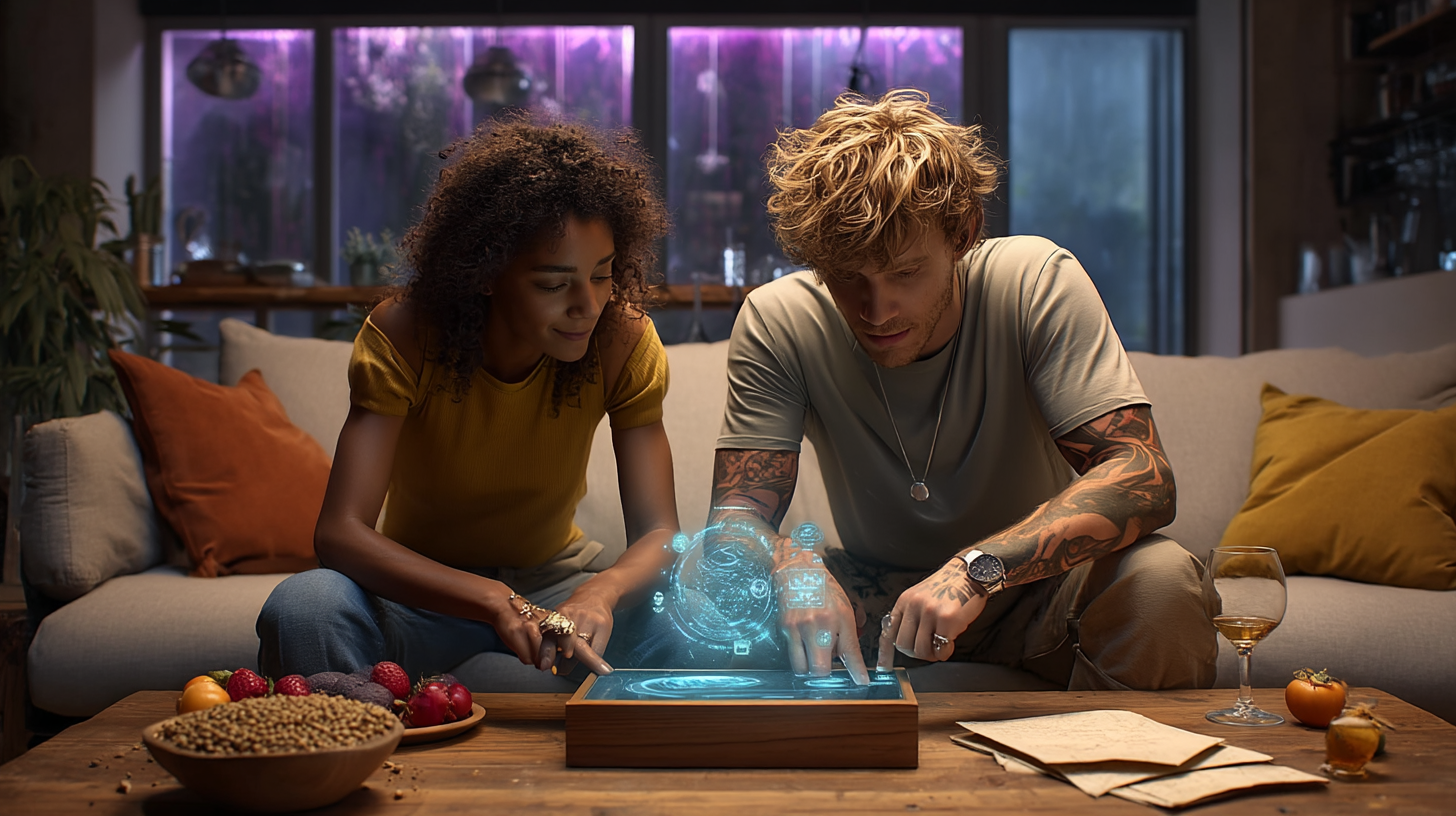
They talk into the night, sketching ideas on Maya’s tablet. The boundaries between their worldviews soften as they remember why they both went into food innovation: to nurture connections between people, bodies, and soil.
“Your community farm, do you ever need help with tech implementation?” Maya asks impulsively. “I’ve been thinking about getting my hands dirty again. Literally.”
Stefan smiles. “We’ve actually been looking for someone to help us connect with urban communities. You’d be perfect.”
“I have vacation days to use,” Maya says. “And my GLP-1 patch works just fine in the countryside.”
“Just don’t ask me to optimize the compost pile with AI,” Stefan warns with a smirk. “The last guy who tried that created what I can only describe as the world’s most analytically perfect bad smell.”
They both laugh, and in that moment, the future of food looks like complementary paths converging: technology and tradition, personal health and planetary regeneration, science and soul.
Connections
- Future Scenario explores what makes a good scenario and why narrative is central to futures work.
- Scenario Planning describes the broader methodology that produces scenarios like this one.
Linked References
No notes link to this note yet.